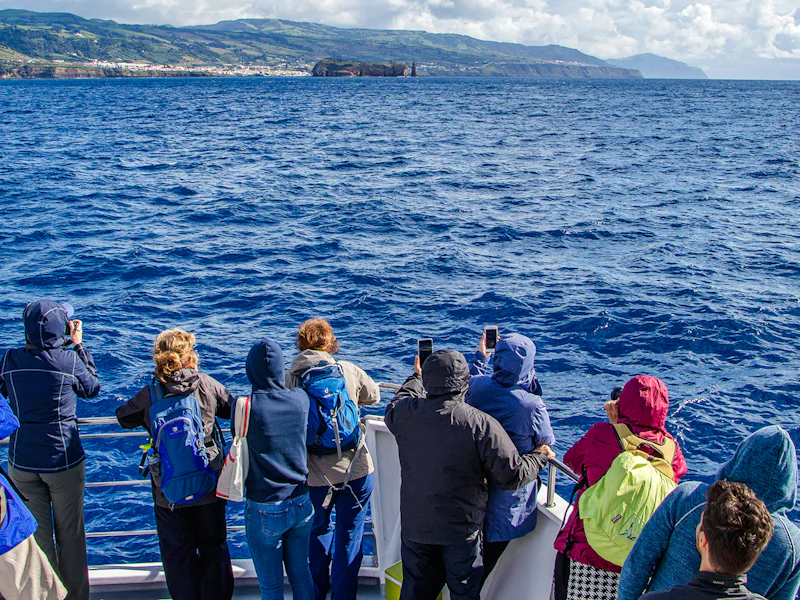
Ponta Delgada
Guided Sao Miguel Whale Watching Tour
Free cancellation3 hrs
from $76
Check availability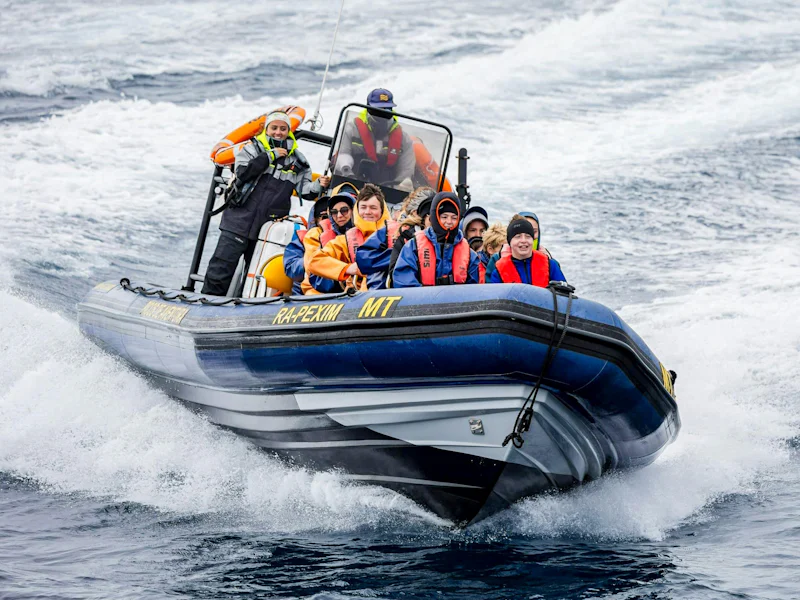
 New
NewWhen whales are around, month by month.
Based on operators' peak-season sighting records.
Chance of seeing whales or dolphins in Azores in peak season
Chance of seeing both whales and dolphins
Based on 92,042 verified sightings logged in Azores: real records, not estimates.
Source: GBIF.org, which aggregates marine mammal observations from OBIS-SEAMAP, Happywhale & iNaturalist. Retrieved October 2026.
The whales and dolphins you can realistically spot here, ranked by how often they are recorded.



Azores whale watching takes you into mid-Atlantic water where more than 20 cetacean species have been recorded, and by some counts 28, close to a third of the world's total. Picture a sperm whale's blunt, barrel-shaped head breaking the surface a few hundred meters off Pico, one low blow angled forward, then the long dark back arching over and the flukes lifting clear before it slides into a dive that usually lasts around 45 minutes. Few places on Earth produce sperm whale encounters this reliably, and the sperm whales are only half the story.
For the whole archipelago, you'll find the best months to go, the four cetaceans you are most likely to meet, the two island bases with links to their own pages, what a typical tour costs and includes, and how to pick a boat. Prices are snapshots of the tours we compare. Most book through Headout with free cancellation, so you can hold a spring date now and change your mind later without losing a cent.
The short answer is April, May and June. Those three months are the peak of the Azores whale watching season, when the giant baleen whales, blue and fin, arrive on their northbound spring migration and pass close enough to the islands to be picked up from the clifftop lookouts. Operators report sighting rates of around 90% at this time of year, and it is the only reliable window for the two largest animals on this page.
March, July, August, September and October are solid shoulder months. The migrating giants thin out once June ends, but the Azores' other specialty, resident sperm whales, along with the large pods of common dolphins that share these waters, do not migrate away, so sightings stay strong through the summer and into fall. If your trip does not line up with spring, a shoulder-season booking is still a good bet.
November through February is the off season. Winter swells in the open Atlantic make for a rougher ride, and far fewer tours run. If you are weighing the Azores against other destinations for a specific month, our guide to the best time for whale watching lines up the seasons side by side.
The vigia advantage. Long before whale watching existed as tourism, the Azores used vigias, shore-based lookouts stationed in stone huts on the clifftops, to spot whales for the whaling boats below. Today those same vantage points are staffed by whale watching companies, and a vigia radios a sighting down to the boats the moment a blow appears, and they head straight for it. That head start is a big part of why Azores whale watching sighting rates rank among the highest in the Atlantic, and in a few cases the vigia on duty is a former whaler doing the same job for a different reason.
More than 20 species of whale and dolphin have been recorded around the islands, according to Visit Azores, the region's official tourism board. Four cetaceans account for most of what a typical Azores whale watching tour encounters.
The Azores' signature species, and one that stays in these waters all year. Males can grow to about 52 feet and 45 tons, with a blunt, box-shaped head, and dive for squid at depths beyond 2,000 feet, a hunt that can last 45 minutes, according to NOAA Fisheries, and occasionally runs past an hour. They then spend several minutes breathing at the surface before the next deep dive. The Azores' deep water close to shore, especially off Pico, means that whole cycle plays out close to the boats. Listed as endangered, with a global population that has never fully recovered from centuries of whaling.
The largest animal that has ever lived, reaching more than 100 feet and feeding almost entirely on krill, filtered from huge volumes of seawater through baleen plates, according to Whale and Dolphin Conservation. In the Azores it is a spring visitor, passing the islands on its northbound migration from April to June as it follows its food supply north through the Atlantic. Listed as Endangered, with a global population of roughly 10,000 to 25,000 left after early twentieth-century whaling took the total above 140,000. If your tour finds one in May, the blow alone, a column of spray several meters high, is unmistakable from a long way off.
The second-largest whale on Earth after the blue whale, reaching 75 to 85 feet and 40 to 80 tons, and listed as endangered under the US Endangered Species Act, according to NOAA Fisheries. Fin whales travel with or near blue whales on the same spring migration, April through June, and the two are sometimes confused at a distance; a fin whale's smaller, more sharply curved dorsal fin is one of the tells experienced guides look for. They are fast, sustained swimmers built for open-ocean crossings like the one the Azores sit in the middle of, so a sighting often means following at a respectful distance while the whale keeps moving.
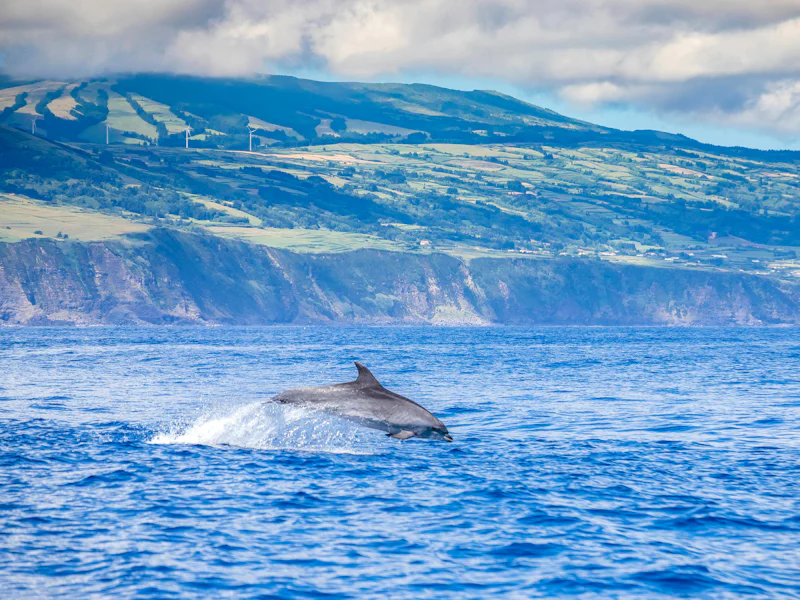
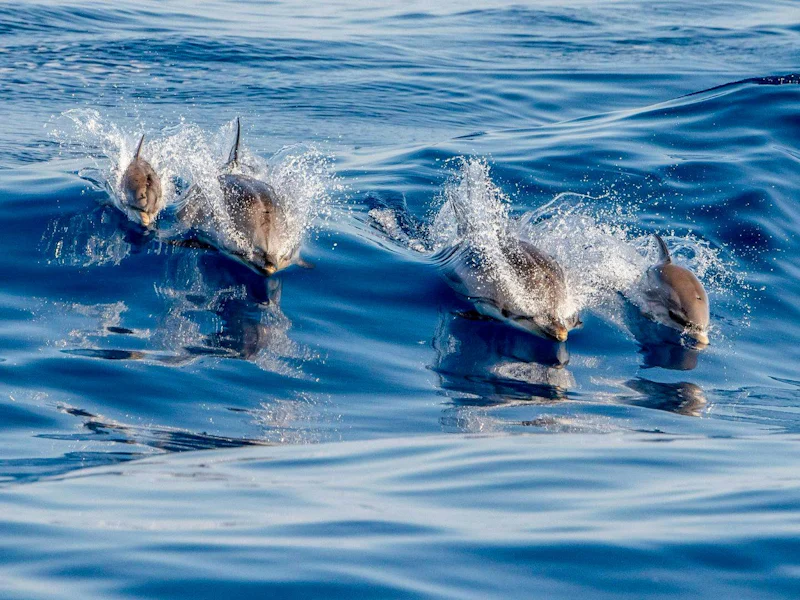
The Azores' most numerous cetacean, moving through these waters in pods that can number in the hundreds, feeding and traveling together and often riding a boat's bow wave the moment the engine slows. They stay year-round, so most tours see them even in months when the deep-diving whales are harder to find. Fast, acrobatic and easy to photograph at the surface, they are frequently the first marine wildlife guides point out on a trip, and for many visitors the pod that stays alongside the boat for ten minutes is the highlight of the day.
Two islands account for most Azores whale watching tours, and each has its own page with the local tours, prices and seasons broken down in detail.
Sao Miguel is the largest and most-visited of the nine islands, and Ponta Delgada, the Azorean capital, is the easiest base to build a trip around, with the widest choice of tour operators and departure times of any island. Vigia spotters along the south coast guide boats out to the resident sperm whales, and in spring those same lookouts pick up the blue and fin whales passing offshore. Tours here run about 3 hours and start from about $76. See our page on whale watching in Sao Miguel for the full tour lineup.
Pico is the Azores' historic whaling island, and Lajes do Pico, on its south coast, was the base for more than a century of open-boat sperm whale hunts, from 1867 until the last one in 1987. The old whalers' lookouts still stand on the cliffs, some staffed today by descendants of the men who once hunted from them, and the same deep water close to shore that made this a productive whaling ground now puts sperm whales within easy reach of the harbor on most trips. Tours run about 3 hours from about $77. Read the full guide to whale watching in Pico for prices and seasons.
If sperm whales are the point of your trip, build it around Pico: more than a century of whaling history and some of the deepest water close to shore anywhere in the Azores.
Most Azores whale watching tours run about 2 to 3 hours and start the same way: a vigia posted on the clifftops scans the water with binoculars, and only once a whale or a pod of dolphins is confirmed does the boat leave the harbor, radioed straight to the sighting. Once at sea, guides narrate what surfaces where, and boats hold back at a legal distance, so patience, and a decent pair of binoculars, pays off.
Sao Miguel and Pico, about 3 hours, from about $76. The standard format: a mid-sized boat with an open deck and a guide narrating the vigia's directions. Good for most travelers and the cheapest way to see sperm whales.
Sao Miguel, about 3 hours, from about $76. This guided listing rates 4.6 across 52 reviews, while Sao Miguel's standard boat tour carries the islands' best record, 4.9 from 193. Smaller groups, more time with the guide, and a slower pace on the water.
Terceira, about 2 hours, from about $128, rated 5.0 from 7 reviews. A specialist snorkel trip that puts you in the water with the dolphins, for travelers who want more than a view from the rail.
As a rule of thumb, the core Azores whale watching tours sit in a tight band of about $76 to $81, among the most affordable in this guide, with the swim-with-dolphins specialty trip on Terceira the outlier at about $128 for a shorter 2-hour outing. A newer combined whale and dolphin tour also lists from about $81; it is too new to carry a review history yet, so weigh it against the established, well-reviewed options above.
Compare every Azores tour side by side: price, boat, duration and free cancellation.
See the toursYou already know what you want: a sperm whale's flukes lifting out of mid-Atlantic water close enough to see the barnacles. What's left to decide is the island, the month and the boat.
Even on a sunny Azorean spring day, the wind off open ocean is cold, and the boat's speed between sightings adds to it. Bring a windproof layer, a hat that will not blow off, and something for your hands. A clear morning on Pico can turn breezy and overcast by noon, so layers you can shed matter more here than on a sheltered bay.
The Azores sit in exposed open Atlantic water, so the ride out can be choppier than on a coastal tour elsewhere. If you are prone to seasickness, take a remedy before boarding rather than once underway, eat a light meal beforehand, and stay on deck watching the horizon.
A vigia's clifftop directions mean you are rarely searching blind, but the whale itself can still be a distant blow before the boat closes the distance. Binoculars turn that first far-off puff into a clear view of the species, and a fast shutter beats a heavy zoom lens on a moving deck.
Azores whale watching operates under an official code of conduct that sets minimum approach distances and limits how many boats can gather at one sighting, according to Visit Azores, the region's tourism authority. Choose operators that visibly follow it: a good boat lets the whale set the pace and never chases or crowds it.
Many Azorean whale watching guides, especially on Pico, come from families that hunted sperm whales from open boats until commercial whaling ended here in the 1980s. Ask about it. The same knowledge of currents, weather and whale behavior that once filled the try-pots now fills the boats with visitors instead, and most guides are glad to talk about the shift.
Come in April, May or June if the giant baleen whales are the goal; any month from March to October works well for resident sperm whales and dolphins. Pick Sao Miguel for convenience or Pico for whaling history and close sperm whale water, choose a boat that matches your budget and stomach, and book early with free cancellation as your safety net, wherever your next whale watching adventure takes you.
April to June is the best window, when resident sperm whales overlap with blue and fin whales passing on their northbound spring migration and peak-season sighting rates run around 90%. March and July to October stay strong for sperm whales and common dolphins, while November to February is the rough, quiet off season. The calendar above breaks it down month by month.
Yes, especially from April to June. The Azores offer one of the most reliable sperm whale encounters on Earth, plus a spring shot at blue and fin whales, and clifftop vigia spotters radio boats straight to a blow so sighting rates reach around 90% in peak season.
Pico and Sao Miguel are the two main bases, and both find the same resident sperm whales and spring giants. Pico offers the closest, most consistent sperm whale encounters from the old whaling port of Lajes do Pico, while Sao Miguel is the easiest to reach, with the widest choice of tours and departure times from Ponta Delgada.
Core Azores tours start from about $76 per person, with most falling in the $76 to $81 range for a roughly 3-hour boat trip, while a swim-with-dolphins specialty on Terceira runs about $128. Boats are similar in format, so choose on departure time, review history and whether you want a standard watch or an in-water swim.
Bookings are processed through Headout, which partners with vetted local operators. Whale Watching is an independent affiliate site. We may earn a small commission if you book through a link here, at no extra cost to you.
Compare tours in Azores and book in minutes. Most offer free cancellation.
See tours in Azores

