Lanzarote
Speedboat Whale And Dolphin Watching Cruise
Free cancellation2.5 hrs
from $41
Check availability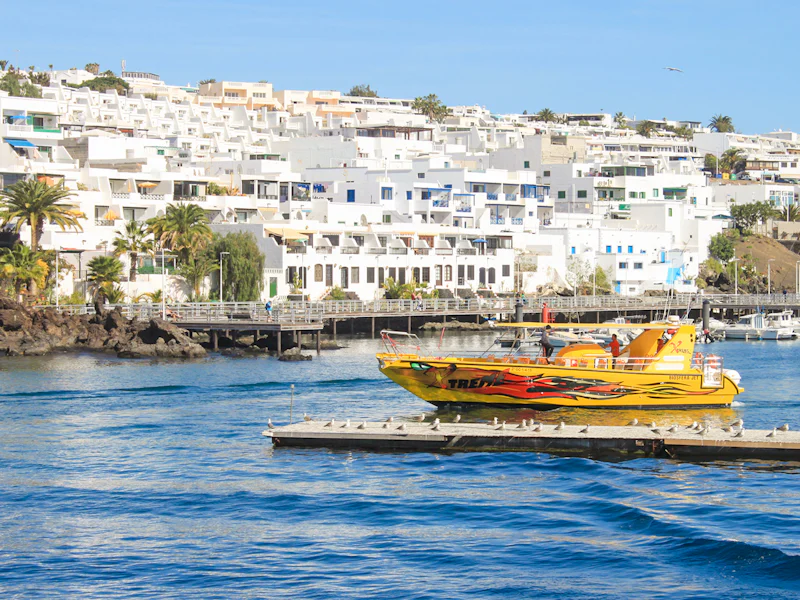
 New
NewMore in Canary Islands: Tenerife All of Canary Islands
When whales are around, month by month.
Based on operators' peak-season sighting records.
Chance of seeing whales or dolphins in Lanzarote in peak season
Chance of seeing both whales and dolphins
Based on 2,827 verified sightings logged in the wider Canary Islands region: real records, not estimates.
Source: GBIF.org, which aggregates marine mammal observations from OBIS-SEAMAP, Happywhale & iNaturalist. Retrieved October 2026.
The whales and dolphins you can realistically spot here, ranked by how often they are recorded.

Lanzarote whale watching centers on one specific piece of water: La Bocaina, the roughly 7-mile channel that separates this island from Fuerteventura, with the low, uninhabited shape of Isla de Lobos sitting at its southern edge, just off Fuerteventura. Picture a speedboat lifting onto the plane as it clears the harbor wall when three or four bottlenose dolphins peel in from open water to ride the bow wave, keeping pace before breaking off toward Lobos. Most Lanzarote trips are sold that way, as a route to somewhere (a nature reserve, a sunset, a snorkel stop), with dolphins met along the way.
Below are the two harbor towns boats sail from, how the Bocaina crossing compares with a dedicated whale-watching cruise, the volcanic coastline you pass on the way out, and what a speedboat, a sailing cruise or a half-day Lobos Island trip costs. For the wider archipelago picture, see the Canary Islands whale watching hub; if your trip also touches Tenerife, that island's cetacean waters work differently, as covered in our Tenerife whale watching guide.
The Bocaina crossing runs on the same steady pattern as the rest of the archipelago, so the month you pick changes little. What changes through the year is the wind. The channel toward Fuerteventura is more open than a sheltered bay, and an afternoon breeze off the Atlantic builds a chop across it on more days than not, especially in spring and summer. Boats that leave Puerto del Carmen or Marina Rubicon before mid-morning tend to get a flatter run out to Lobos and back.
Summer and the school-holiday stretches around Christmas and Easter bring the closest thing to a busy season, driven by visitor numbers rather than any change in dolphin activity. Late spring is when a fin whale is most likely to pass through the strait, though one turns up too rarely to build a trip around. If you are weighing Lanzarote against a more seasonal destination, our best time to go whale watching guide lines up every region side by side.
A smaller fleet than Tenerife's, on purpose. Lanzarote never grew the resort-scale whale-watching business that built up around Tenerife's south coast marinas; the boats here are fewer, mostly small independent operations working out of two low-key harbor towns. Groups stay smaller and the pace stays unhurried, but it also means fewer sailings a day and less room to switch dates if one is full or canceled for weather, so locking in a date matters more here than on a bigger island.
Four cetaceans turn up on a typical Bocaina crossing, though only one of them is common enough to expect on most sailings.
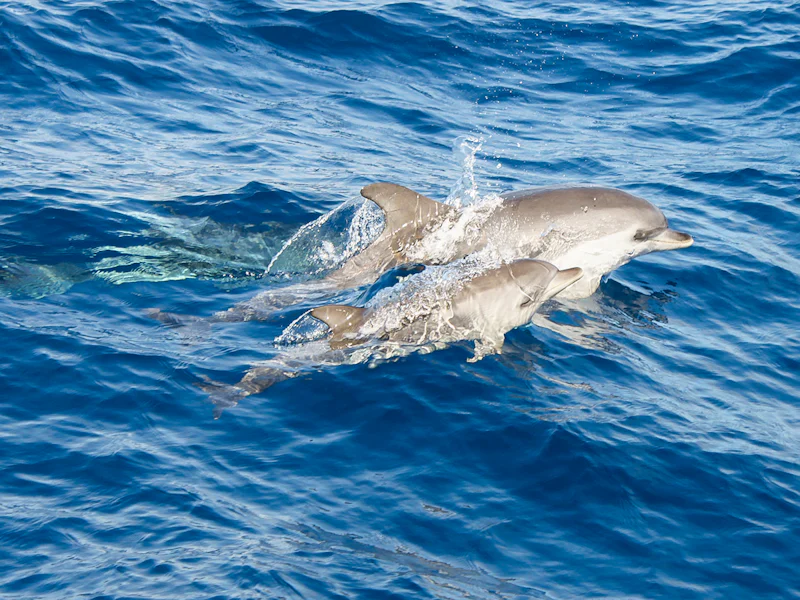
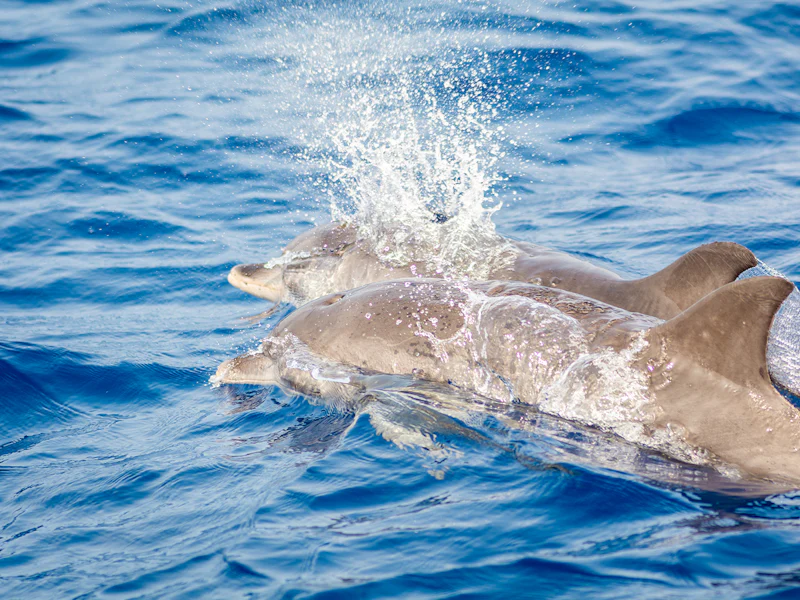
The animal behind most of Lanzarote's sighting numbers, working the strait in small, loose groups rather than one fixed colony tied to a single bay. NOAA Fisheries notes that bottlenose dolphins hunt cooperatively, using echolocation clicks to locate fish and sometimes herding a school into open water where several animals feed at once, a strategy well suited to a channel like the Bocaina. They are also the species most likely to ride the pressure wave off the bow before peeling off toward Lobos.
Less predictable than the bottlenose but a highlight whenever a pod turns up, usually from late spring into early autumn when this warmer-water species ranges closer to the islands. Calves are born plain gray and only gain their namesake spotting with age, so one pod can show every stage at once, clean-sided youngsters mixed in with heavily mottled adults, all leaping together off the bow.
An occasional visitor to the Bocaina, which sets Lanzarote apart from Tenerife, where a catalogued pod stays inside its strait year-round. Pilot whales are among the deepest-diving dolphins on record, some tracked well past 1,000 feet chasing squid, so an encounter here usually means a small group resting near the surface, dark backs and a low, curved fin rolling slowly through the water.
The rarest sighting on this page and by far the largest, passing through on a wider spring migration without stopping to feed near the island. At up to 85 feet and built for speed, fin whales can sprint faster than most other great whales, so a sighting is usually a tall blow on the horizon and a long, dark back rolling under before the animal moves on.
Two harbor towns on Lanzarote's south and southeast coast handle nearly all of the island's whale watching departures, both within a short run of the Bocaina crossing.
Lanzarote's largest resort town has its own working harbor, and it is the departure point for the island's longest whale-watching-adjacent outing: the half-day run south across the Bocaina to Isla de Lobos, a protected nature reserve with a single beach and no permanent population. Speedboats also leave from here for shorter crossings that skip the stop ashore for a quicker, cheaper trip. Puerto del Carmen sits closer to the airport and to most of Lanzarote's hotels than Playa Blanca does, the easier base if you are not staying in the far south.
Playa Blanca's marina looks straight across open water at Fuerteventura and Lobos, and it has the shortest crossing on the island, part of why sunset sailing cruises are based here: a boat can reach the channel, find dolphins and still be back at the dock as the light turns gold over the volcanic cliffs behind the marina. Rubicon is smaller and quieter than Puerto del Carmen's harbor, with a handful of independent operators, so trips from here tend to run in smaller boats carrying fewer passengers.
Tenerife's whales live in one strait and stay there. Lanzarote's cross a channel to somewhere else, and a Bocaina trip takes you along for that ride.
A Lanzarote trip is closer to a boat day with a wildlife stop built in than to a dedicated whale-watching cruise. Whichever harbor you leave from, the crew heads out into the Bocaina with someone watching the water, and most cut the engine once dolphins are found so the animals set the pace. The scenery is volcanic the entire way out: the cliffs above Playa Blanca and along the Papagayo coast were shaped by the same 1730s eruptions that built Timanfaya further north, so the coastline framing the crossing to Lobos is lava rock from the harbor wall to the open channel. Your choice of boat shapes the day more than your choice of harbor.
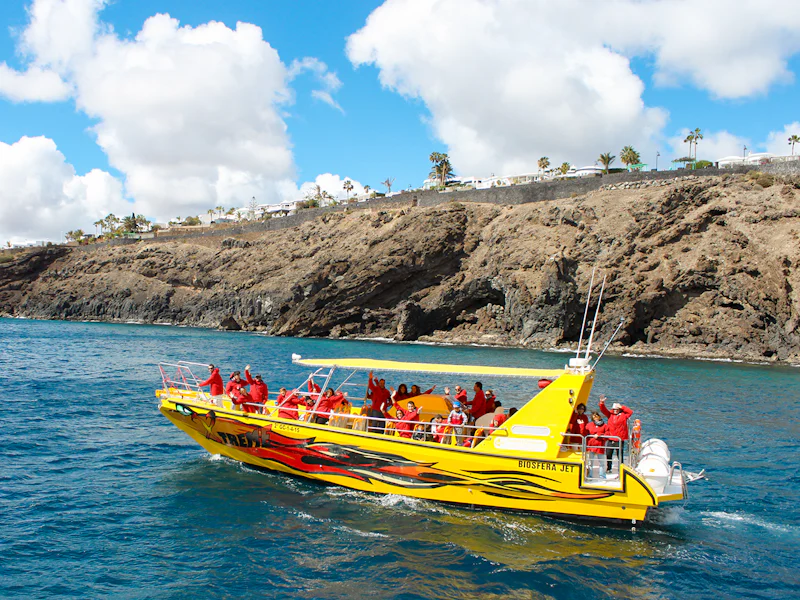
2.5 hours, from about $41 out of Puerto del Carmen. The fastest and cheapest way onto the water, a direct run out into the Bocaina and back, built for anyone who wants the crossing without giving up a whole afternoon to it.
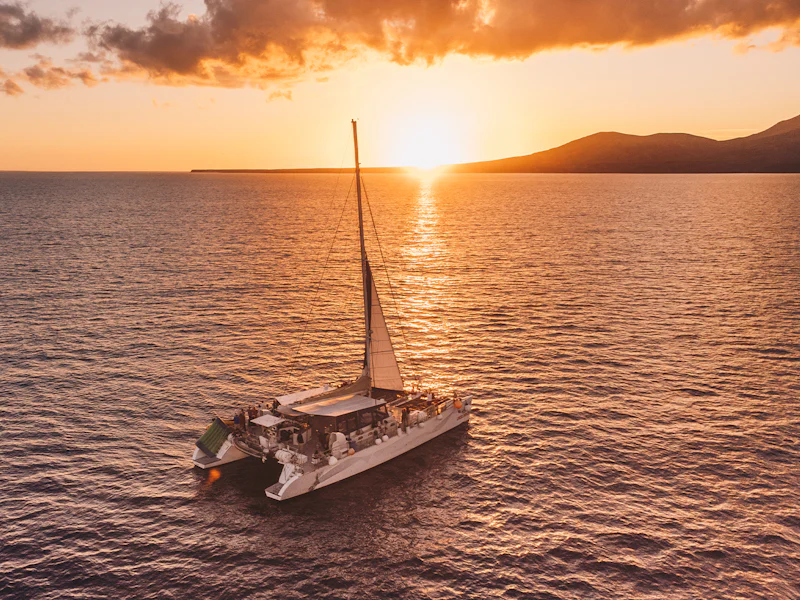
2 hours, from about $62 out of Marina Rubicon, or about $60 for a 2.5-hour sunset speedboat with transfers. A sailboat rather than a motor launch, quieter in the water and timed so the volcanic coastline glows on the way back in, Lanzarote's version of a low-key evening on the water.
4 hours, from about $87. A smaller boat with fewer passengers than the half-day option, spending more time searching and drifting alongside dolphins once they are found, run by one of the island's independent operators.
5 hours, from about $84 out of Puerto del Carmen. The longest standard outing on the island, pairing the dolphin crossing with time ashore on Lobos itself, a stop none of the shorter options include.
Outside the private option, Lanzarote's crossings run about $41 to $87, a tighter band than Tenerife's, mostly because the island's fleet is smaller. The one private booking on this page climbs to about $872 for four hours on a boat to yourselves, priced for exclusivity rather than for better odds of finding dolphins.
See Lanzarote's tours side by side, with price, boat, duration and free cancellation for each.
See the toursWith the odds holding steady across the calendar, what is left to decide on Lanzarote is the harbor, the boat and how much of the day you want to spend on the water.
The Bocaina is more exposed than a sheltered bay, so expect more spray and motion than a calm-harbor trip. A light waterproof layer over swimwear beats an outfit you would mind getting wet, and reef-safe sunscreen matters on an open deck with little shade.
The open channel toward Fuerteventura carries more swell than a sheltered strait, especially once the afternoon breeze picks up. Take a remedy before boarding and pick a morning sailing if motion sickness is a concern.
Operators who follow the Canary Islands' whale and dolphin watching rules fly the Barco Azul, or Blue Boat flag, marking vessels that keep an approved distance from the animals. It is a quick, visible check before you book.
The half-day option is the only one that lands on the island itself, a protected reserve with one beach and no permanent population. That stop turns the dolphin crossing into a proper half-day out, and it is worth the extra hours if you have them.
A morning sailing out of Puerto del Carmen or Marina Rubicon still leaves the afternoon free for Playa Blanca's beaches or a drive up to Timanfaya National Park, whose lava fields shaped the same volcanic coastline the boat runs past on the way to Lobos.
Most tours leave from two harbors in the south: Puerto del Carmen on the southeast coast, base for speedboats and the half-day trip to Lobos Island, and Marina Rubicon at Playa Blanca, closest to Fuerteventura and home to the sunset sailings. Both reach the same dolphin grounds in the Bocaina strait.
High. Canary Islands sailings find dolphins or whales about 96% of the time in any month, and off Lanzarote the bottlenose dolphins working the Bocaina strait toward Fuerteventura carry most of those sightings. Pilot whales visit only occasionally here. Most trips are speedboat or sailing cruises, some with a stop on Isla de Lobos.
No single month stands out: every month carries the same peak rating here, since the dolphins do not migrate away. Odds stay around 96% year-round. Warmer months from late spring to early autumn add larger Atlantic spotted dolphin pods, and spring can bring migrating fin whales.
Lanzarote tours start from about $41 per person, with most falling between $41 and $87 depending on the boat, the trip length and extras like a stop on Lobos. A 2.5-hour speedboat from Puerto del Carmen is the cheapest, sunset sailings and the half-day Lobos trip cost more, and a 4-hour private cruise runs about $872.
Bookings are processed through Headout, which partners with vetted local operators. Whale Watching is an independent affiliate site. We may earn a small commission if you book through a link here, at no extra cost to you.
Compare tours in Lanzarote and book in minutes. Most offer free cancellation.
See tours in Lanzarote