Plan your trip
When to go & what you'll see in Oahu
Best time to go
When whales are around, month by month.
J
F
M
A
M
J
J
A
S
O
N
D
Peak seasonGoodOff-season
Sighting probability
Based on operators' peak-season sighting records.
Chance of seeing whales or dolphins in Oahu in peak season
Real sightings by month
Based on 1,867 verified sightings logged in Oahu: real records, not estimates.
Source: GBIF.org, which aggregates marine mammal observations from OBIS-SEAMAP, Happywhale & iNaturalist. Retrieved October 2026.
What you'll see
The whales and dolphins you can realistically spot here, ranked by how often they are recorded.

Humpback whaleThousands arrive each winter to breed and calve.1,713 sightings

Spinner dolphinResident pods spin clear of the water.154 sightings
Oahu whale watching: humpbacks off Waikiki all winter long
Oahu whale watching puts you within sight of North Pacific humpback whales without ever leaving the city, and in peak season the odds are excellent: sightings run around 99% on a January, February or March cruise. Picture leaving Waikiki's beach strip behind on a sunset sailing, the high-rises shrinking astern, and then a humpback's back rolling through the swell against a sky going orange over the Waianae range, a common sight off Honolulu from December into April.
Below you will find the Oahu whale watching season month by month, the two species you are most likely to meet, where the boats leave from, what the one Oahu whale watching tour we compare involves, and how it stacks up against nearby Maui if you have a choice of islands. The tour listed here is bookable through Headout with free cancellation, so you can hold a peak-season date now and change your mind later at no cost, the same flexibility worth having for any trip built around whale watching.
~99%peak-season sighting rate
2headline species: humpback & spinner dolphin
Dec-Aprhumpback whale season
$64+real tour compared
Best time for whale watching in Oahu
The short answer is January, February and March. Those three months are the peak of the Oahu whale watching season, when the largest numbers of North Pacific humpback whales are in Hawaiian waters and sighting rates on tours run around 99%. The whales migrate roughly 3,000 miles from Alaska, a trip some individuals complete in as few as 28 days according to NOAA Fisheries, and they spend the winter breeding, calving and nursing in the warm, calm water around the islands, Oahu included.
December and April are the shoulder months. Whales are already arriving by December and are still passing through in April on their way back north, so sightings are good but not yet, or no longer, at the winter peak. May through November is the off season for Oahu whale watching: the humpbacks have returned to their North Pacific feeding grounds, and a cruise in these months is not built around finding one. If you are choosing dates around a wider trip, our guide to the best time to go whale watching lines up seasons across every destination we cover.
Oahu's second season never stops. While the humpbacks come and go with the calendar, Hawaiian spinner dolphins live around Oahu year-round. They rest in calm nearshore water by day and feed offshore at night, so even outside the December to April humpback window, a boat trip off Honolulu or the Waianae coast can still turn up dolphins riding the wake or spinning clear of the water.
What whales you'll see in Oahu
Two cetaceans anchor the case for whale watching in Oahu, and they could hardly be more different: one is a 40-ton winter visitor, the other a small, acrobatic resident that never leaves.
Humpback whale
Thousands of humpback whales arrive in Hawaiian waters each winter to breed and calve, and Oahu sits inside that range along with the rest of the archipelago. According to the Hawaiian Islands Humpback Whale National Marine Sanctuary, roughly half of the entire North Pacific population, described by NOAA as thousands of animals, migrates to Hawaii every winter and spring, and the sanctuary's protected waters extend around Oahu as well as Maui, Hawaii Island, Molokai, Lanai and Kauai. Most adults run roughly 45 to 50 feet, the biggest close to 60, and off Waikiki you are most likely to see a single animal or a small group surfacing, blowing and occasionally slapping a pectoral fin or tail before a longer dive. According to NOAA Fisheries, the species has been increasing in abundance across much of its range since the 1985 international whaling moratorium, and the IUCN Red List classifies the humpback whale as Least Concern globally, with an estimated 84,000 mature individuals and a growing population trend, though some regional groups remain more vulnerable than the overall number suggests.
Spinner dolphin
Hawaiian spinner dolphins are a resident, island-associated population, so unlike the humpbacks they are around Oahu in every month of the year. The name is literal: a spinner can complete several full body rotations in a single leap, and a fast-moving pod is often the liveliest thing on the water on any given day. By day they move into calm, shallow bays to rest and socialize, then head into deeper water overnight to feed on fish and squid. Because daytime is their rest period, NOAA Fisheries protects them closely, and it is illegal to swim with, approach or remain within 50 yards of a Hawaiian spinner dolphin within two nautical miles of the main islands' shore. A good boat gives them room and waits for a curious pod to come over to the hull.
Where to go: Oahu whale watching departure points
Oahu is one stop on an archipelago-wide season. The same North Pacific humpbacks that pass Waikiki spread across the whole island chain each winter, and our guide to whale watching in Hawaii covers how the islands compare if your trip is not fixed to Oahu alone.
Waikiki and Honolulu
- Best for: Convenience
- From $64
- 1.5-hr sunset cruise
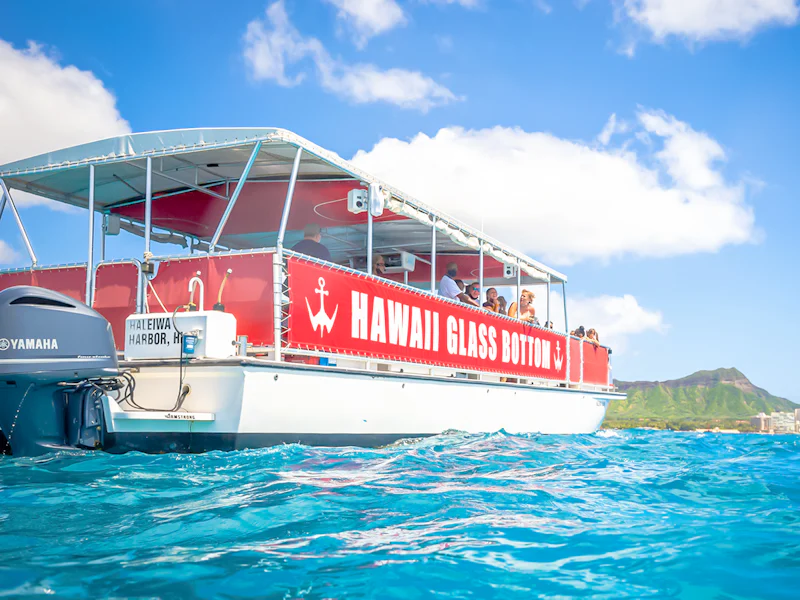
Waikiki is where nearly every visitor to Oahu is already staying, and it is also where the island's whale watching boats leave from, which makes this the easiest whale trip in Hawaii to fit around a beach vacation. You need no rental car or early drive, just a short walk to the harbor and a boat headed out past Diamond Head. The Waikiki Sunset Cruise is the one Oahu whale watching tour we currently compare: a 1.5-hour sailing rated 4.4 from 118 reviews, from about $64. It is styled as a sunset cruise rather than a dedicated whale boat, so expect an evening sailing with cocktails and Honolulu's skyline as much as a narrated wildlife trip, with humpback sightings as the seasonal highlight from December through April.
Oahu's west side, the Waianae coast, is the other place locals mention for whale watching, since its waters open more directly onto the channels where humpbacks travel and the shoreline itself is a decent spot to see a blow or a breach from land. It is not currently home to a bookable tour we track, so for now Waikiki is the practical starting point if you want to get on the water.
If Oahu is where your trip is based, you do not need to go looking for whales. From December to April, they come within sight of Waikiki on their own schedule.
What an Oahu whale watching tour is like
The Waikiki Sunset Cruise leaves in the late afternoon and runs about 1.5 hours, timed so the boat is out on the water as the light turns gold and the humpback activity of the day is often at its most visible. It is a catamaran-style sunset sailing rather than a small, fast whale boat, so you get a stable deck, an open bar or drinks service depending on the package, and a crew watching for whales alongside the usual sunset commentary. Book it if you want an easy, sociable evening on the water with a good chance of whales. If you want a guide narrating every blow and fluke the way a dedicated whale watching boat in Maui or Iceland would, this is the wrong boat.
Sunset cruise
1.5 hours, from about $64. A catamaran-style evening sailing out of Waikiki with drinks and Honolulu skyline views built in, and whale sightings likely in season. The only Oahu whale watching tour we currently compare, and a comfortable, low-effort way to combine a classic Waikiki evening with a fair shot at humpbacks.
At about $64 for 1.5 hours, the Waikiki Sunset Cruise sits well below the cost of a dedicated whale watching boat on Maui, which reflects what it is: a sunset sailing where whales are a seasonal bonus. If a focused, guide-narrated whale trip matters more to you than the Waikiki setting, it is worth comparing against the dedicated catamarans that leave from Kaanapali and Maalaea on Maui, a short flight away.
Compare every Oahu tour on price, boat, duration and free cancellation.
See the toursHow to choose the right Oahu whale watching tour
With one tour on this page, the decision comes down to picking the right dates and knowing what you are booking.
- Aim for January through March.This is the peak of the Oahu whale watching season, with sighting rates around 99%. December and April still see whales but in smaller numbers, and May through November is not the season to plan around.
- Know it is a sunset cruise, not a dedicated whale boat.The Waikiki Sunset Cruise is built around an evening sail with drinks and skyline views, with whale sightings as a seasonal highlight. Book it for that experience, and treat the whales as the bonus they are marketed as.
- Book the peak-season evening early.Sunset sailings have limited capacity and winter evenings are popular with visitors who are not even thinking about whales. Free cancellation on the listing means locking in a date costs you nothing if your plans shift.
- Check the reviews.The Waikiki Sunset Cruise carries a 4.4 rating from 118 reviews at the time of writing, a solid signal for a trip that is part sunset sail, part wildlife outing.
- Consider Maui if whales are the whole point.Oahu whale watching is the convenient option when your trip is based in Honolulu. If the whales themselves are the priority and you have the flexibility, whale watching in Maui runs on the same season with a higher density of sightings and boats built specifically for it.
Tips for whale watching in Oahu
Dress for an evening on the water
Even in a Hawaiian winter, the wind picks up once the boat is moving and the sun starts to drop. A light jacket or wrap over your evening clothes is worth having for a sunset sailing, along with sunglasses for the last hour of daylight and a layer for anyone who runs cold on open water.
Bring a real camera or a steady phone
A humpback's blow or back is often visible well before it is close, so binoculars help you spot activity early. For photos, hand-hold the camera with a fast shutter, and it is worth putting the camera down for at least one sighting so at least one of them is not seen through a screen.
Watch responsibly
Hawaii's humpback whales are protected by a 100-yard approach law that applies statewide, year-round, to vessels, and spinner dolphins get their own 50-yard rule within two nautical miles of shore. Whale and Dolphin Conservation notes that humpbacks make some of the longest migrations of any whale, between polar feeding grounds and tropical breeding waters like the one off Oahu, so a boat that lets the animals set the pace is doing right by an already exhausted traveler.
Your evening is part of a bigger picture
The waters around Oahu sit inside the Hawaiian Islands Humpback Whale National Marine Sanctuary, created to protect the breeding, calving and nursing grounds that draw whales to the islands every winter. Every respectful sighting, kept at a legal distance, supports the same population researchers track from Alaska to Hawaii and back.
The simple recipe
Book a January to March evening if your dates allow it, go in knowing you are on a sunset cruise with a strong chance of whales. It is the easy way to see a humpback from Honolulu; for the highest whale density in the islands, Maui is a short flight away.
Good to know
Oahu whale watching FAQ
January, February and March are the best months in Oahu, the peak of the season, when the most North Pacific humpbacks are in Hawaiian waters and sighting rates run around 99%. December and April are good shoulder months. From May through November the humpbacks have returned north, so cruises are not built around finding them.
Waikiki is the practical base, with boats leaving the harbor and heading out past Diamond Head, making this the easiest whale trip in Hawaii to fit around a beach holiday. The Waianae coast on the west side opens more directly onto the humpback channels and is a good spot to watch from land, though bookable tours there are limited.
Maui has the higher whale density, thanks to the Auau Channel nursery, so it is the stronger choice if seeing whales is the main goal. Oahu reaches the same North Pacific humpbacks on the same winter season and is far more convenient if you are already staying in Waikiki, just at a lower whale density.
Oahu tours start from about $64 per person for a 1.5-hour Waikiki sunset cruise, the most affordable format in Hawaii. It is styled as a sunset sailing with drinks and Honolulu skyline views, and humpback sightings are the seasonal highlight from December through April. For a dedicated, guide-narrated whale boat, look to Maui.
Bookings are processed through Headout, which partners with vetted local operators. Whale Watching is an independent affiliate site. We may earn a small commission if you book through a link here, at no extra cost to you.
Ready to find your whale in Oahu?
Compare tours in Oahu and book in minutes. Most offer free cancellation.
See tours in Oahu