Hervey Bay
From Hervey Bay Half Day Whale Watching Cruise
Free cancellation4 hrs
from $111
Check availability
More in Australia: Sydney Gold Coast Perth Newcastle Brisbane Cairns All of Australia
When whales are around, month by month.
Based on operators' peak-season sighting records.
Chance of seeing whales or dolphins in Hervey Bay in peak season
Based on 14,003 verified sightings logged in Hervey Bay: real records, not estimates.
Source: GBIF.org, which aggregates marine mammal observations from OBIS-SEAMAP, Happywhale & iNaturalist. Retrieved October 2026.
The whales and dolphins you can realistically spot here, ranked by how often they are recorded.
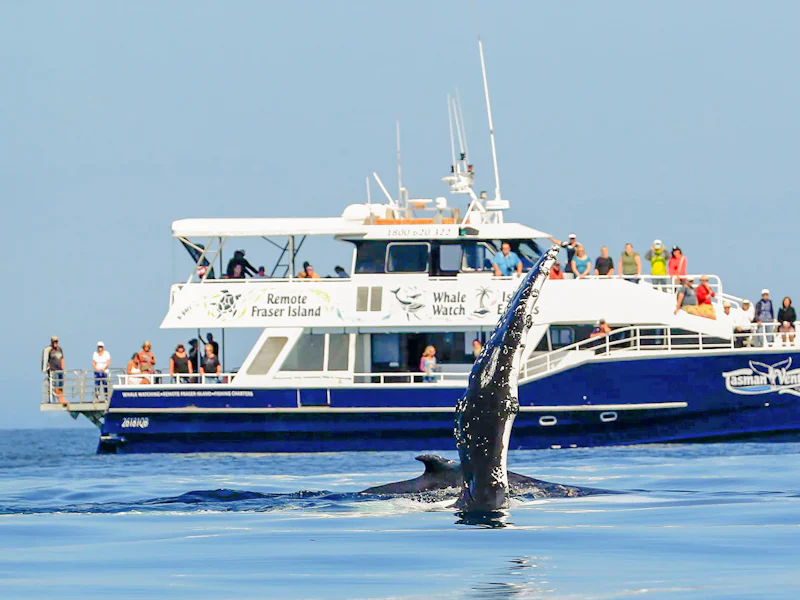
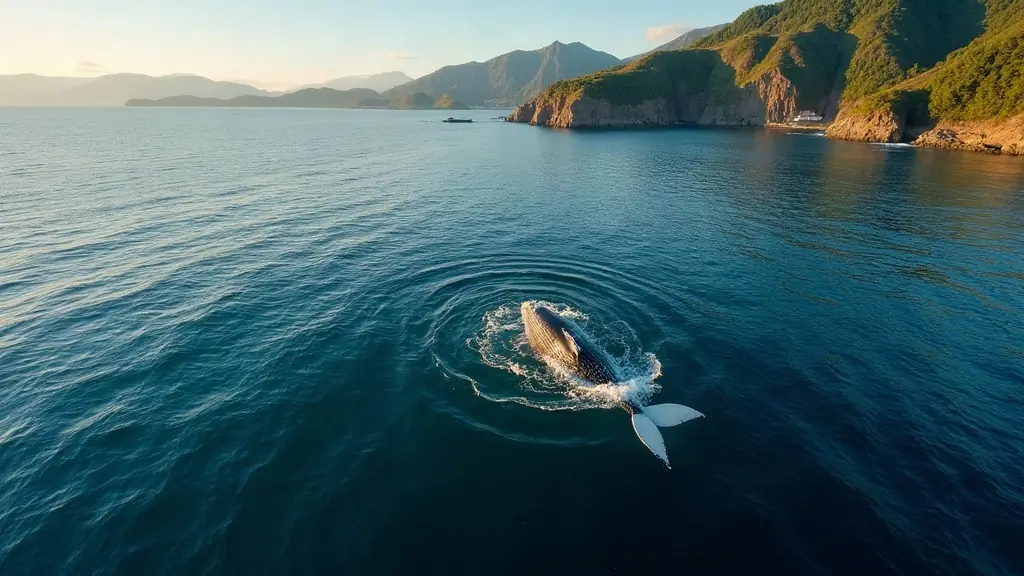
Hervey Bay whale watching is built around a pause. Sheltered by the long sand mass of K'gari (Fraser Island), the calm waters of Platypus Bay give southbound humpback mothers and their calves a place to stop for days on their migration back to Antarctica, and that pause is why encounters on this stretch of Queensland coast tend to run long and close. Boats here rarely need to hunt down a fast-moving pod. They idle beside a mother and calf who have nowhere urgent to be, and often it is the whale that closes the distance, rising beside the hull to look back at the people looking at it. Locals and guides call this "mugging," and it is Hervey Bay's signature.
Further down you will find the best months to go, the whales and dolphins you are most likely to meet, where the boats leave from, what a Hervey Bay whale watching tour costs and feels like, and how to pick between the two tours we compare. Both are bookable through Headout with free cancellation, so you can hold a peak-season date now and change your plans later at no cost.
August, September and October are the three peak months for whale watching in Hervey Bay, with sighting rates of around 96% in that stretch. The bay runs on a later clock than the rest of the coast. The first humpbacks arrive in late July, once the northbound migration has passed the Queensland coast and whales start turning south, numbers peak through August and September, and from September onward southbound mothers and calves make Platypus Bay their resting stop before the long swim back to Antarctic feeding grounds. That mother-and-calf wave, strongest in October, is the one Hervey Bay is famous for.
Late July and November are the shoulder weeks. Adult and younger whales without calves are more common early in the season, and mother-calf pairs become more frequent as it goes on, so an early August or November trip still carries a good chance of a sighting, with a different mix of whales than an October cruise. December through mid-July falls outside the working season for Hervey Bay whale watching tours, when boats are not running trips. If you are weighing Hervey Bay against other Australian or international destinations for a specific month, our guide to the best time to go whale watching lines up the seasons side by side.
The "mugging" phenomenon. Platypus Bay is a resting stop, so the whales here are relaxed and in no hurry to move on. That is what produces mugging: a mother and calf, or a small pod, choosing to approach a stationary boat and linger alongside it, sometimes for many minutes, rolling and spy-hopping close enough to see an eye. This behavior is why operators and researchers set Hervey Bay apart from the other stops on the humpback migration.
Hervey Bay whale watching centers on one headline species, with a rarer whale and a reliable dolphin filling out most trips. An estimated 40,000 humpback whales pass this stretch of coast each year, and they are what every guide on the water is scanning for.
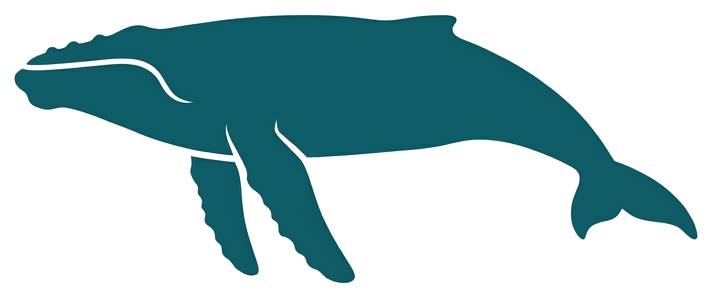
Tens of thousands of humpbacks migrate along this coast each winter, and more than 8,000 of them turn Hervey Bay's Platypus Bay into a resting and nursing stop on the way back to Antarctica. According to NOAA Fisheries, adults reach up to about 60 feet and 40 tons, with calves born at 13 to 16 feet after an 11-month pregnancy and staying close to their mothers for roughly a year. In Hervey Bay that closeness is easy to see: mothers swim with a calf tucked against a flipper, surfacing together, and it is this pairing, more than any single breach or tail slap, that visitors remember.
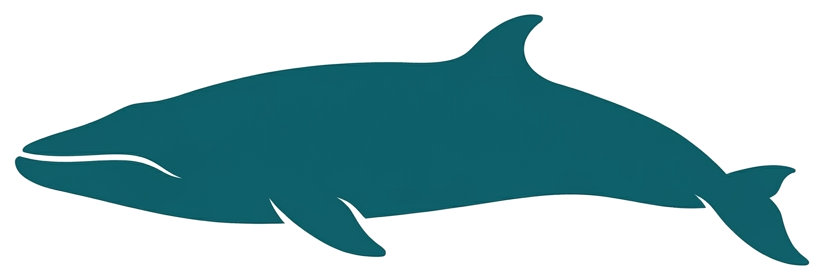
A rarer visitor. Count it as a bonus, since sightings are too irregular to plan a trip around. According to Whale and Dolphin Conservation, southern rights are stocky, rotund whales reaching up to about 55 feet and roughly 90 tons, with no dorsal fin and distinctive raised, cream-colored patches of skin called callosities, arranged in a pattern unique to each individual. Sightings inshore have been increasing at Hervey Bay in recent years, occasionally close enough to shore to see mothers with new calves, part of a slow recovery from a whaling history that pushed the species to the edge.
Regular company on most Hervey Bay cruises, whether or not a whale shows up that day. Common dolphins travel in pods that can range from a handful of animals to a large, active group, recognizable by the hourglass pattern of tan and gray along their sides. They are fast, curious and happy to ride a boat's bow wave, which makes them an easy, reliable sighting between longer stretches of scanning the horizon for a whale's blow.
Every Hervey Bay whale watching tour leaves from the same place: Urangan Boat Harbour, on the southern side of the bay, where the Great Sandy Straits Marina lines up whale-watch boats alongside fishing and pleasure craft. From there, boats cross open water toward Platypus Bay, on the sheltered western side of K'gari (Fraser Island), the deep, calm stretch of the Great Sandy Marine Park where whales come to rest.
This whole stretch of coast, spanning Hervey Bay and Platypus Bay, was named the world's first Whale Heritage Site by the World Cetacean Alliance in October 2019, a recognition of both the whale numbers here and the community built around them, from an annual month-long Hervey Bay Whale Festival to local research and education programs. If your Australia trip takes you further down the coast, our guide to whale watching in Sydney covers the migration as it passes the country's biggest city, and the overview of whale watching in Australia ties every region together.
In Platypus Bay, more often than not, it is the whale that comes to look at you.
Both Hervey Bay whale watching tours we compare here run a similar shape: a half-day, 4-hour cruise from Urangan Boat Harbour out to Platypus Bay, with a safety briefing at the dock, a cruise to the whale grounds, an extended period watching and drifting near whales as the guide narrates what is surfacing, and the run back to the harbor. Because Platypus Bay is sheltered by K'gari, the water is calmer than open-ocean whale watching elsewhere on the Queensland coast, so viewing sessions tend to be longer and steadier.
4 hours, from about $111. The standard Hervey Bay format, with open deck and indoor space and a guide narrating the sightings. Currently rated 5 stars, though on a single review so far, so it is too early to read much into it.
4 hours, from about $86. Similar route and length, with three separate viewing decks so you can move for a better angle, plus refreshments included in the price. Also rated 5 stars from a single review to date.
As a rule of thumb, Hervey Bay whale watching tours sit in a tight band of about $86 to $111 for a 4-hour half-day cruise, so the extras matter more than the price when you choose. Both are new enough on the tours we compare that their star ratings rest on a single review each, so treat the rating as an early, encouraging sign and weigh it alongside what each cruise includes.
Compare every Hervey Bay tour side by side: price, boat, duration and free cancellation.
See the toursWith only two tours to weigh, choosing in Hervey Bay comes down to matching the season and the format to what you want from the day.
Hervey Bay's subtropical climate can feel warm on land even in the August to October peak, but a boat deck on open water is cooler and windier than the shore suggests. Bring a light jacket, a hat and sunscreen, since the sun reflecting off the water is stronger than it looks. Platypus Bay's shelter from K'gari means calmer conditions than many open-water whale watching destinations, but a breeze still picks up once you are moving.
Because Platypus Bay is sheltered by K'gari, the water is generally calmer than an open-ocean whale watching trip elsewhere on the coast. If you are still prone to seasickness, take a remedy before boarding, eat a light meal beforehand, and watch the horizon rather than your phone during the crossing.
A distant blow is usually the first sign of a whale anywhere, so binoculars are worth packing. In Hervey Bay, though, mugging encounters can bring a mother and calf close enough to the boat that binoculars become unnecessary and a wide-angle lens does more work than a long zoom.
Whale watching in Queensland waters is governed by strict approach rules. According to the Queensland Government's rules for watching marine mammals, boats must stay outside a 300-meter caution zone around a whale and a 100-meter no-approach zone, cannot exceed 6 knots inside the caution zone, and must let the whale set the pace, including turning off engines if an animal approaches too closely. A responsible Hervey Bay operator follows these rules and never chases a mother and calf for a closer look.
Hervey Bay and Platypus Bay were named the world's first Whale Heritage Site in October 2019, recognition built on both the scale of the humpback migration here and a community that has built research programs, an annual whale festival and school education around it. Whale watching operators, researchers and the Fraser Coast community all treat these whales as a shared local landmark.
Come between August and October if you can, favor October if a mother-and-calf encounter matters most to you, pick the tour format that suits your budget and your appetite for a view from three decks instead of one, and book early with free cancellation as your safety net, the same approach that serves you well at any whale watching destination.
October is the month Hervey Bay is famous for, when southbound mothers and calves rest in sheltered Platypus Bay, and August and September are also strong. Sighting rates in that August to October peak run about 96%. The first whales arrive in late July and tours run into early November.
The Hervey Bay season starts in late July, when the first humpbacks turn into the bay on their way back south. Numbers build through August and September, and from September mothers and calves take over, peaking around October as they rest in Platypus Bay. Tours run into early November before the season winds down.
In Hervey Bay it matters less than at most destinations, because the whales rest in sheltered Platypus Bay for days rather than passing through, so both the morning and afternoon half-day cruises tend to find them. Mornings often bring lighter wind and calmer water, so lean that way if you are prone to seasickness.
Hervey Bay tours start from about $86 per person, with most half-day, 4-hour cruises falling between about $86 and $111 depending on the boat and what is included. Both trips leave from Urangan Boat Harbour for the calm water of Platypus Bay, so departure time and viewing decks make the better tiebreakers.
Bookings are processed through Headout, which partners with vetted Hervey Bay operators. Whale Watching is an independent affiliate site. We may earn a small commission if you book through a link here, at no extra cost to you.
Compare tours in Hervey Bay and book in minutes. Most offer free cancellation.
See tours in Hervey Bay