 Bestseller
Sydney
Sydney Whale Watching Cruise With Marine Biologist Commentary
2.8 hrs
from $49
Check availabilityBestseller Bestseller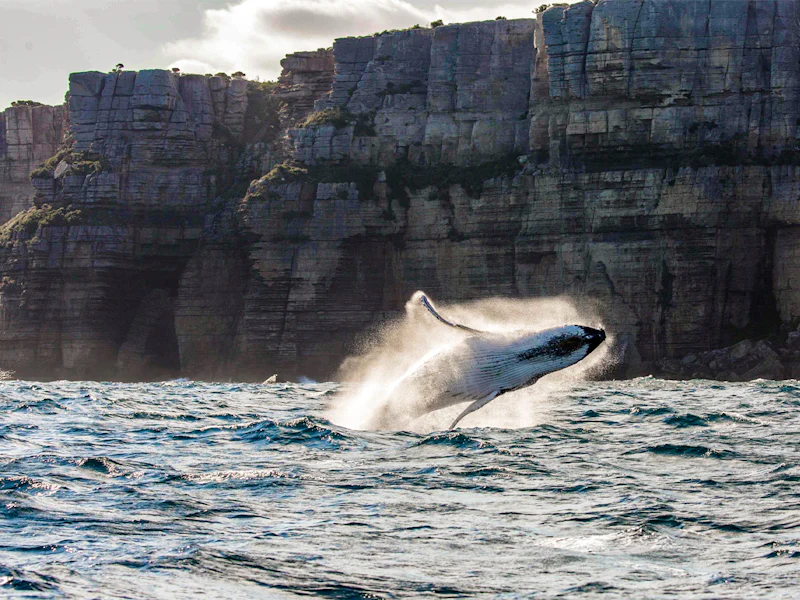
More in Australia: Gold Coast Perth Newcastle Brisbane Cairns Hervey Bay All of Australia
When whales are around, month by month.
Based on operators' peak-season sighting records.
Chance of seeing whales or dolphins in Sydney in peak season
Based on 2,163 verified sightings logged in Sydney: real records, not estimates.
Source: GBIF.org, which aggregates marine mammal observations from OBIS-SEAMAP, Happywhale & iNaturalist. Retrieved October 2026.
The whales and dolphins you can realistically spot here, ranked by how often they are recorded.
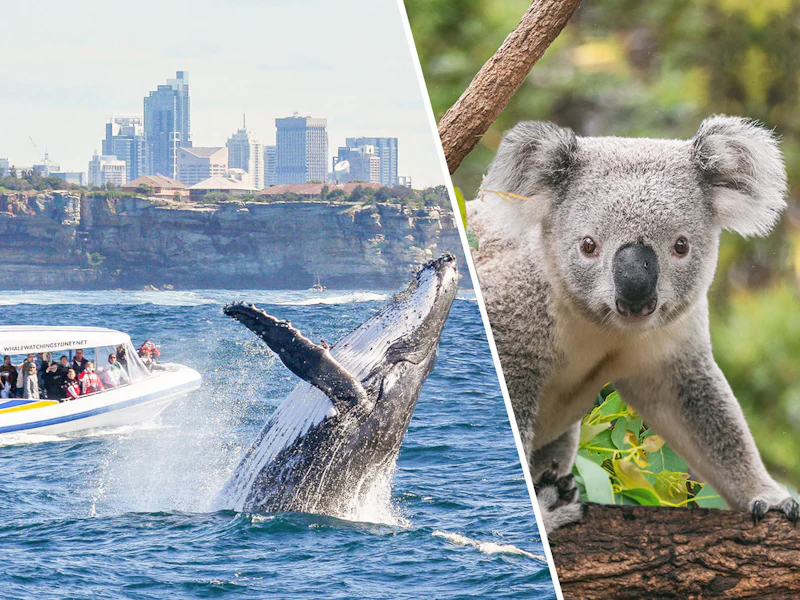
Sydney whale watching happens at the narrowest, most dramatic pinch point on the east coast migration, where the continental shelf closes in and forces the humpback highway between two sheer sandstone cliffs barely two kilometers apart. North Head and South Head stand like open gates at the harbor mouth, and migrating whales funnel through the gap on both legs of the journey, close enough that a boat clearing the Heads is often already inside whale water. Picture a boat rounding South Head into open swell as a fluke lifts against the cliff face, sandstone glowing orange in the morning light. Few other stops on the migration put a whale in front of a cliff like that.
Below is the month-by-month season, the species most likely to surface, the harbor departure points boats use, the free clifftop spots where you can watch without a ticket, what a tour costs, and how to pick between the eight we compare. Prices are snapshots of current listings, most bookable through Headout with free cancellation, so a peak-season date can be held now and released later at no cost. For how Sydney compares with the rest of the coast, the whale watching in Australia hub lines up every region side by side.
Sydney's season runs roughly May through November, with the tightest odds in June, July and October. The first two catch the northbound push, when humpbacks come down off Antarctic feeding grounds and drive hard toward warmer breeding water off Queensland, moving fast enough that a boat sometimes gets only a few minutes with a pod before it moves on. October belongs to the return leg, slower and more drawn out, as mothers travel south with calves born earlier in the season and stop more often to rest off the Heads. In those peak months the tours we track land sighting rates around 96%, a little lower in the shoulder weeks either side.
May, August, September and November carry the season without quite matching it: May is the leading edge of the northbound run, August the changeover between directions, and September and November steady southbound months with smaller crowds on the boats. From December to April the passage empties out almost entirely and most Sydney operators pause dedicated trips until the following autumn. The best time to go whale watching guide sets this calendar against every other region we cover.
Why the cliffs matter as much as the calendar. Most of the New South Wales coast has a wide, shallow continental shelf that keeps deep water well offshore. At Sydney it narrows sharply, and the seafloor drops away almost directly beneath the Heads, so whales that would otherwise pass many kilometers out are pulled in against the cliff line instead. That is why a short harbor cruise here reaches open-ocean whale water in well under an hour, and why the cliffs double as free viewing platforms.
Three animals make up nearly every sighting logged on a Sydney boat, though the balance between them shifts as the season runs its course.
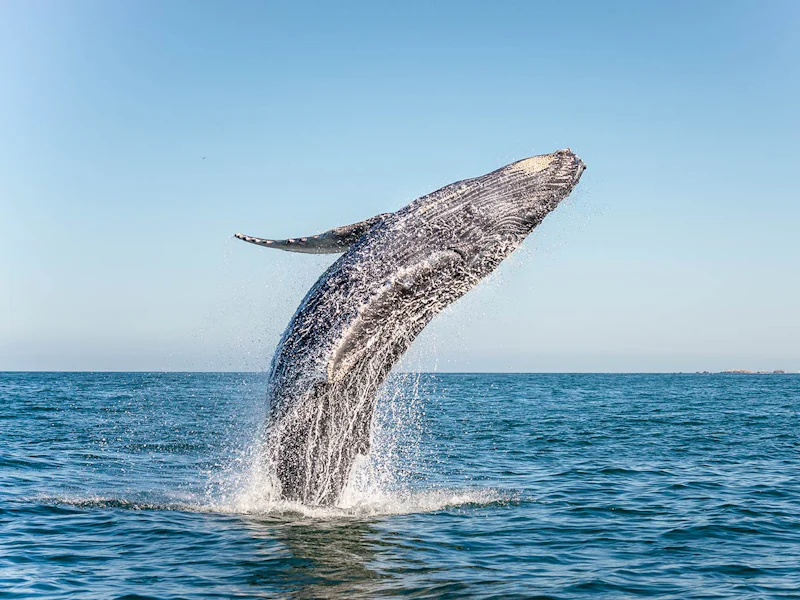
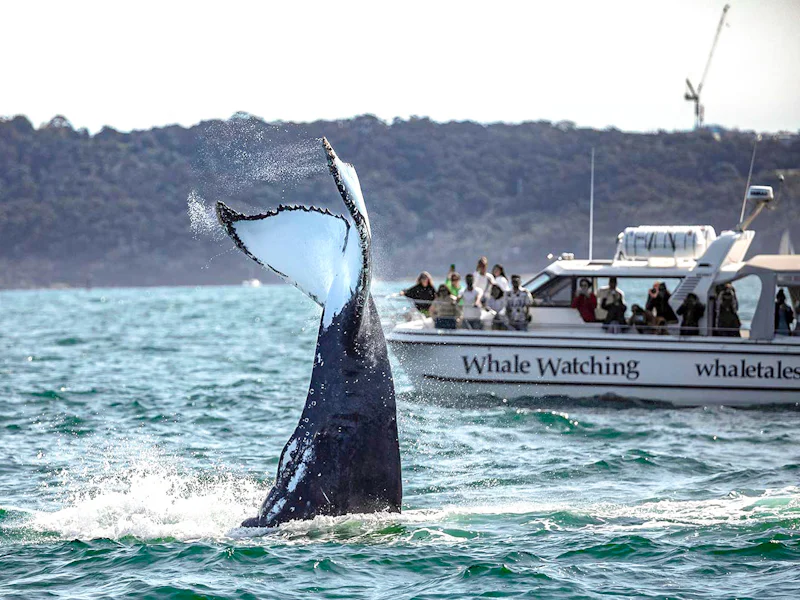
The animal the whole passage is built around. Adults pass Sydney at up to about 60 feet and 40 tons, and because deep water sits so close to the cliffs, boats regularly watch full breaches out in open ocean just past the Heads. Northbound humpbacks in June and July tend to be single adults or small groups moving with purpose; the October return brings slower mothers and calves that rest and surface repeatedly in one patch of water. Government surveys have tracked this stock climbing from somewhere between 100 and 500 whales in the early 1960s to tens of thousands today.
An occasional visitor, more likely spotted from a clifftop lookout than from a boat, since individuals sometimes linger off South Head or Bondi for hours. No dorsal fin and pale, crusted patches of skin called callosities on the head make it unmistakable once spotted, a pattern distinct enough that researchers use it like a fingerprint. Numbers stay low compared with the humpback run, which is why a confirmed sighting off Sydney tends to circulate fast among the people who watch for them.
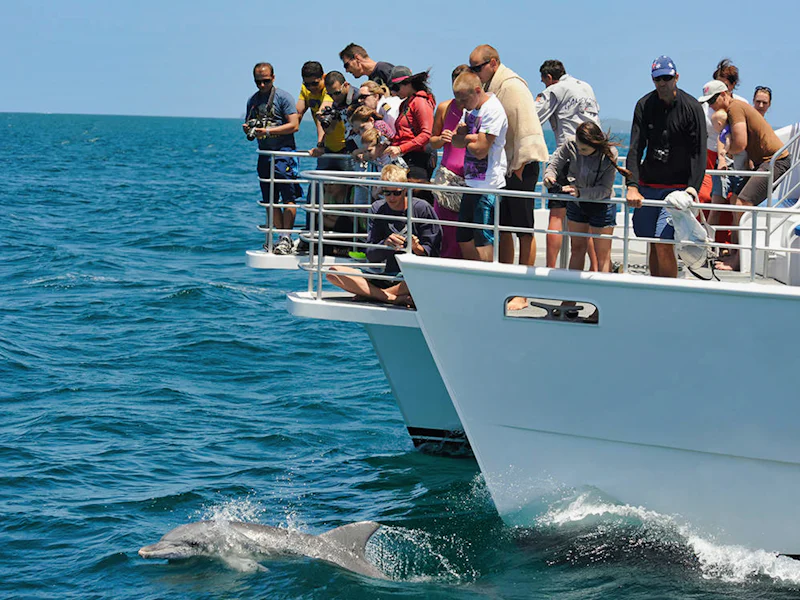
Present in the harbor and just outside it in every season, whale migration or not. Fast-moving common dolphin pods often cross a boat's path on the run out past the Heads, while bottlenose dolphins tend to work the harbor entrance itself, sometimes visible from the Manly ferry on an ordinary commute. Crews frequently use a dolphin pod as a marker, since whales are often working the same general stretch of water not far beyond them.
Two harbor precincts handle nearly all of Sydney's boat departures, and a short list of clifftop spots covers the free, land-based alternative.
Boats leave from the pontoons at Circular Quay, directly below the Opera House, and from Darling Harbour a short walk away, then run the length of the harbor before clearing South Head into open water. Because that run to open ocean is so short, crews are scanning whale habitat well inside the first half hour, while many coastal tours motor for hours to reach a distant feeding ground. A smaller cluster of operators run south to Jervis Bay instead, a separate stretch of coast with its own resident dolphin pods and calmer water than the open Tasman Sea beyond the Heads.
Sydney is one of the few migration cities where a serious sighting does not require a ticket. The Fairfax walking track at North Head, the clifftop path around South Head near Watsons Bay, and the coastal walk from Bondi through Tamarama, Bronte and Clovelly to Coogee all sit directly above water the whales use. Ben Buckler, the rocky point at Bondi's northern end, draws a small crowd with binoculars on clear winter mornings, and further south at Kurnell, the covered platform at Cape Solander is built for whale watching, with whales sometimes passing within a couple of hundred meters. A boat gets you closer, but the cliffs work well when a cruise does not fit the schedule.
Sydney's boats find their whales close to home: clear South Head and the deep water starts right there, cliff still in view.
Most trips spend 1.5 to 4 hours on the water, and the Taronga Zoo combo stretches to a 7-hour day. Each one follows the same pattern: a dockside safety briefing, a cruise the length of the harbor, then the run past the Heads into open swell where the search starts. Because that crossing is short, boats are usually scanning productive water inside thirty to forty minutes of leaving the pontoon, and the deeper offshore conditions beyond the cliffs let crews cover more ground before settling near an animal than they would in shallower water further up the coast. Once a whale is located, boats generally cut engines and drift, letting it set the distance.
About 2 to 3 hours, from about $49 to $61, including a marine-biologist-narrated cruise from $49 and a catamaran cruise from $61 carrying 548 reviews on the tours we track. The steadiest option: an enclosed cabin plus an open deck, room to move around, and a guide narrating what surfaces. The default choice for families and first-timers.
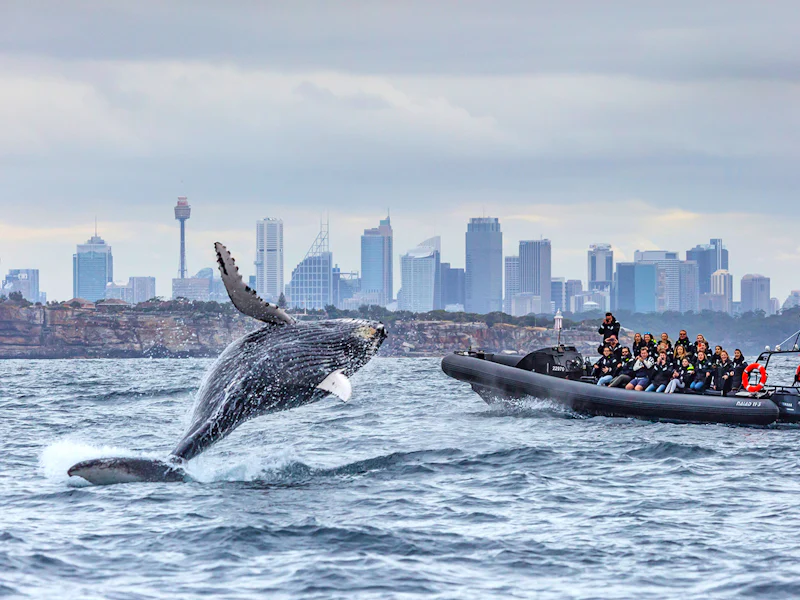
About 2 to 2.5 hours, from about $107. Built for the deeper water past the Heads: lower to the surface, quicker to reposition when a whale surfaces some distance off, and a noticeably livelier ride than the cruise boats. Not the pick for young children or anyone who wants to stay dry.
About 4 hours, from about $75 for a breakfast or lunch cruise, up to $97 for a 7-hour combination with Taronga Zoo entry carrying 299 reviews. These trips fold the Opera House, Harbour Bridge and the rest of the working harbor into the same outing, aimed at travelers who want the city skyline to be part of the memory too.
About 1.5 to 2 hours on the water, from about $42 for a dolphin cruise up to $61 for a dedicated whale watching run. A calmer, more sheltered stand-in about three hours' drive south of the city, worth considering if the open Tasman Sea past the Heads sounds rougher than you want.
As a rough guide, the eight Sydney tours we compare span about $42 to $107, with the Jervis Bay dolphin trip the cheapest full outing and the inflatable-boat format the most expensive standard listing. Against most other whale watching destinations worldwide, that buys a roughly 96% peak-season sighting rate and a crossing to open water measured in minutes.
Compare all eight Sydney tours by price, boat, duration and free cancellation.
See the toursWith almost every operator working the same short harbor-to-Heads route, your choices come down to calendar, boat and how much of a city outing you want built in.
Circular Quay can feel mild and sheltered while the water past the Heads is windy and noticeably colder, with more spray once the boat clears the harbor mouth. A windproof layer, closed shoes and sunscreen against the glare off open water matter more here than the conditions at the dock suggest.
The harbor stretch is gentle, but the swell beyond South Head can build quickly, especially on an inflatable boat. Anyone prone to it should take a remedy before boarding, eat lightly beforehand and keep their eyes on the horizon during the crossing.
The Bondi to Coogee walk, North Head and Cape Solander all put you above the migration route for free, and binoculars turn a distant blow into a clear sighting from any of them. It also makes a useful backup plan on a morning when tours are booked out or the forecast looks marginal.
New South Wales sets minimum approach distances for vessels around whales, and the state's national parks agency publishes guidance built around not disturbing animals that are migrating, resting or traveling with a calf. A crew that idles and waits rather than motoring straight at a sighting is doing it the way the rules intend.
The east coast humpback population was cut to an estimated 100 to 500 animals by commercial whaling and has since rebuilt into the tens of thousands passing Sydney each year. Conservation groups that track humpback numbers globally rank this stock among the clearer success stories, so even an ordinary Tuesday sighting off the Heads is a small piece of that comeback.
Aim for June, July or October, pick a standard cruise for comfort or an inflatable for speed, and book early with free cancellation as the safety net. If calmer, more sheltered water sounds better suited to your group, whale watching in Gold Coast covers the same migration on a gentler stretch of coast further north.
May to November, when around 40,000 humpback whales pass Sydney on the migration known as the Humpback Highway. June and July are busiest as the whales head north, while September to November brings mothers and calves back south, often closer to shore. The month-by-month calendar above breaks it down.
Yes. Sydney sits right on the humpback migration route, and boats from Circular Quay and Darling Harbour log a sighting on about 96% of peak-season trips. You can also watch for blows from headlands like North Head, free of charge.
For most visitors between May and November, yes: sightings are near-reliable at about 96% in peak season, and the humpbacks are often active, breaching and slapping close to the boat. Outside those months there is little to see.
Sydney tours start from about $42 per person, with most falling between $42 and $107 depending on the boat, the trip length and extras like lunch. Larger catamarans are steadier and good for families, while smaller express boats reach the whales faster, so weigh comfort and departure time alongside price.
Bookings are processed through Headout, which partners with vetted local operators. Whale Watching is an independent affiliate site. We may earn a small commission if you book through a link here, at no extra cost to you.
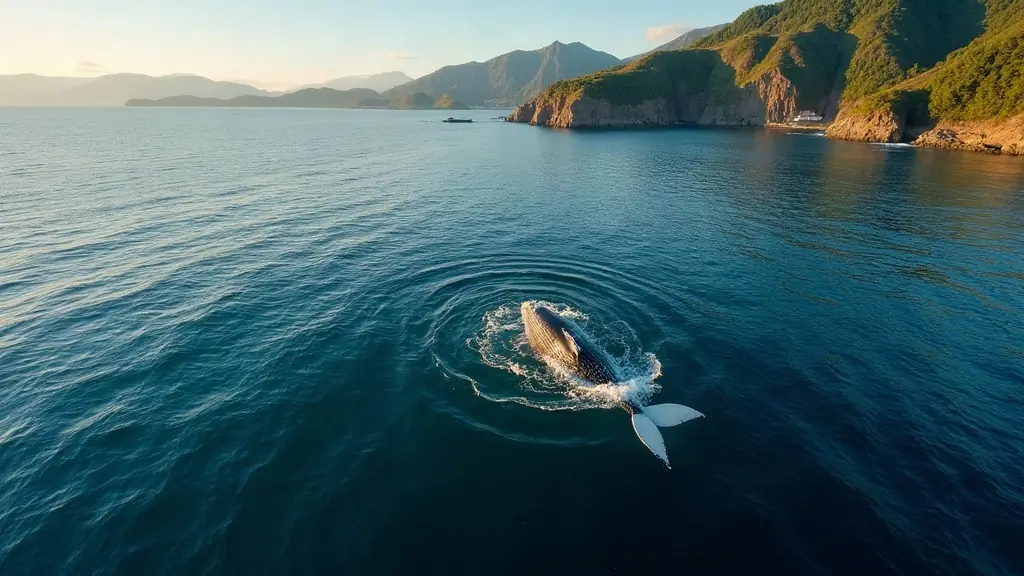
Compare tours in Sydney and book in minutes. Most offer free cancellation.
See tours in Sydney